





How Many Catalytic Converters Does a Car Have?
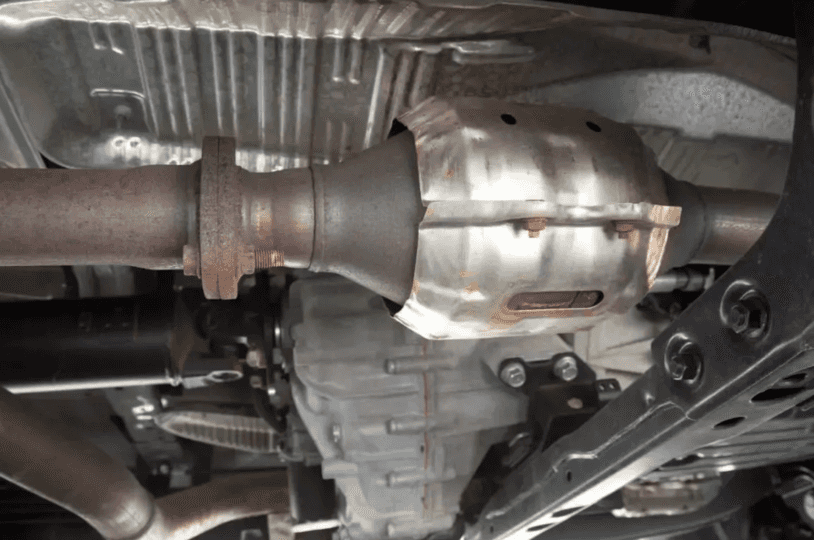
Photo Source/Copyright: Cars.com
“How many catalytic converters does a car have?” sounds like a single-number question, but the real count lands anywhere between zero and four. What decides that tally isn’t vehicle size; it comes down to cylinder layout, exhaust routing, and cold-start emissions engineering.
What the Converter Actually Does
Mounted directly in the exhaust path between the manifold and muffler, a catalytic converter chemically treats whatever the engine pushes out. Inside sits an internal honeycomb coated with rare metals: platinum, palladium, and rhodium.
As raw exhaust passes through, those metals convert carbon monoxide, unburned hydrocarbons, and nitrogen oxides into far less harmful gases before anything exits the tailpipe.
Those precious metals explain the steep replacement cost, but they also explain why a healthy converter works quietly for years without a second thought.
Engine Layout Sets the Count
Cylinder architecture dictates how many converters an automaker installs. Consider the Ram 1500, a truck offering three distinct engine setups: a Pentastar V-6, a HEMI V-8, and a twin-turbo Hurricane inline-six. Park them side by side, and you’ll see three different exhaust layouts:
- Inline-Four: Typically runs one or two converters. One unit can clean the stream from a single cylinder bank, though modern setups often add a close-coupled pre-cat near the manifold.
- Inline-Six: Varies by design. While inline-sixes use a single bank, twin-turbo plumbing can divide the exhaust into separate paths.
- V-6 and V-8: Usually require two or more units. With two cylinder banks, giving each side its own converter prevents either bank from doing the work alone, and some systems add downstream units ahead of the muffler.
- Full Electric Vehicles (EVs): Carry zero. Pure EVs like the Dodge Charger Daytona skip combustion entirely, leaving no tailpipe, no emissions inspection, and no converter to steal. Hybrids like Ram’s eTorque still burn gasoline, so they clean exhaust the traditional way.
Pre-Cats and Doubled-Up Systems
Converters only scrub exhaust once they get hot, and cold exhaust pipes take time to warm up. To solve this, engineers bolt a compact pre-cat directly against or inside the exhaust manifold, where it heats fast and cleans early during cold starts. Farther down in the mid-pipe under the floor, a larger main converter handles the heavier flow once the engine reaches operating temperature.
That’s why looking from underneath on a creeper might reveal only one visible converter while another sits tucked high in the engine bay. If you ask a service advisor how many you have, they’ll usually ask for your VIN first.
Warning Signs of a Failing Converter
When a converter begins to fail, it usually drops clear hints:
- A Check Engine light triggered by a P0420-series catalyst-efficiency code.
- A rotten-egg or sulfur smell at the tailpipe.
- A metallic rattle underneath from fractured internal honeycomb material.
- Sluggish acceleration and choked power at highway speeds.
- A failed state emissions inspection.
Theft, Warranty, and the VIN
Precious metal content makes converters prime targets for thieves, but shields or VIN etching offer inexpensive protection. If yours fails or gets cut out, federal law bars anyone, private owners included, from pulling a converter or running a straight pipe.
Replacements must be OEM or certified units installed in the factory position, and California requires aftermarket units to carry an official CARB Executive Order number stamped on the label.
Federal law protects original converters against defects for 8 years or 80,000 miles, though theft and damage fall outside warranty coverage. If you’re unsure what’s bolted under your vehicle, book a service visit, where a technician can run your VIN, put the car on a lift, and show you exactly what’s there.
More From Miami Lakes Dodge Chrysler Jeep Ram
Why No 2026 Dodge Charger Hellcat?
Photo Source/Copyright: Stellantis Here’s the straight answer: you can’t walk into a showroom and order a 2026 Dodge Charger Hellcat. That car doesn’t exist, not as a 2026, and not as a 2027. The last supercharged Charger rolled off the line for 2023, and the new generation launched without a V-8. The good news?…
Complete Guide to the Dodge Challenger SXT
Photo Source/Copyright: [INSERT] Short answer first: The Dodge Challenger SXT trim served as the entry-level V-6 doorway into Dodge’s retro coupe, and 2023 was the final model year to order one new. Production wrapped up that December. If you want an SXT today, you’ll be shopping the pre-owned market. Alternatively, if you want…
Exploring the Retro Jeep Wrangler Rewind Edition
Photo Source/Copyright: Jeep Nobody walks past this one without stopping, and that’s the entire point. As part of Jeep’s Twelve 4 Twelve campaign, where a new limited-edition vehicle drops on the 12th of every month, the sixth release leans heavily into neon, arcade cabinets, and high school parking lot nostalgia. Named the Rewind,…