




Tackle Jeep Gladiator Transmission Problems With Confidence
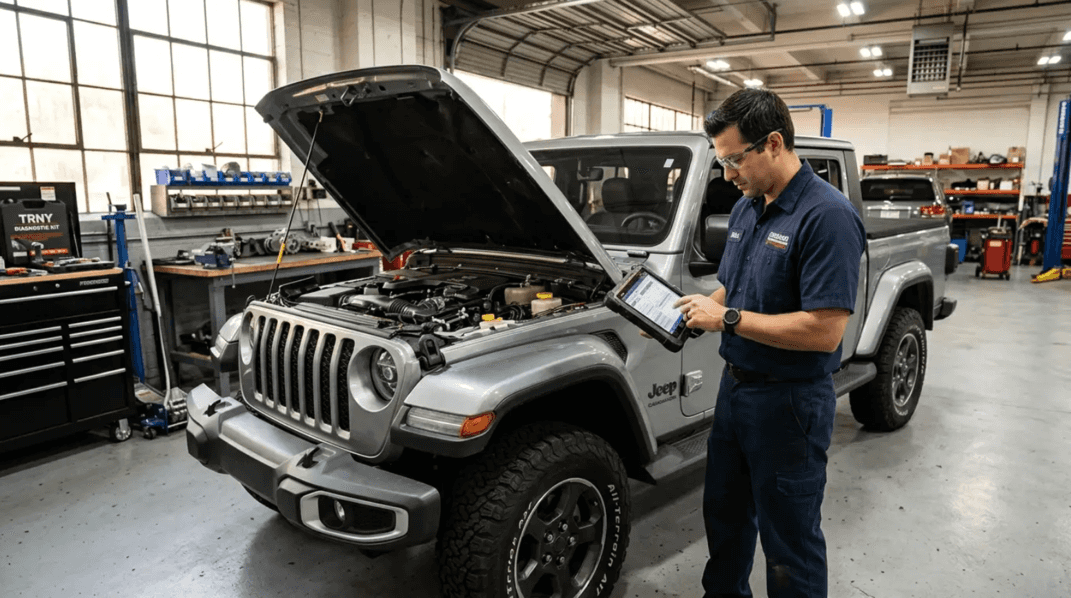
Photo Source/Copyright: Stellantis
Most drivers who start searching online for Jeep Gladiator transmission problems end up feeling far calmer than when they first opened their browser. The 850RE eight-speed automatic sitting behind the 3.6-liter Pentastar V-6 has been running in Stellantis trucks long enough that its operational quirks are well-documented, widely understood, and usually fixable with software updates rather than costly hardware replacements. That operational track record provides considerable peace of mind for prospective buyers and current owners alike.
Understanding the 850RE Gear Ratio Math
The 850RE isn’t a lazy gearbox; it manages a broad ratio spread designed to tackle heavy trail work and highway cruising with equal skill.
- First Gear (4.71:1): Provides a deep crawl ratio that allows the truck to navigate steep terrain and rocks without overloading drivetrain components.
- Eighth Gear (0.67:1): Substantially drops engine revolutions per minute (RPMs) at high speeds, keeping highway driving quiet and reducing overall fuel consumption.
- Intermediate Gears: Six intermediate gear ratios allow the transmission to constantly adjust to throttle position, vehicle load, and terrain.
- Adaptive Controls: The electronic control unit continuously monitors driving habits and adjusts shifting patterns, meaning a Gladiator at 20,000 miles naturally shifts differently than it did on day one.
Recognizing Common Transmission Symptoms
Understanding how specific symptoms manifest helps owners describe issues accurately during a dealership or shop visit:
- Light-Throttle Shudder: A subtle vibration felt through the seat between 40 and 60 miles per hour (MPH) usually points to torque converter clutch slip rather than internal gear damage.
- Delayed Engagement: Shifts that land roughly half a second after throttle input often reflect software timing or hydraulic delay rather than mechanical failure.
- Burnt Fluid Odor: A distinct burnt smell following heavy towing indicates that transmission fluid has exceeded its optimal operating temperature.
- Visible Leaks: Red or brown fluid spots under a parked truck are typically traced to aging pan gaskets or loose cooler line fittings.
- Diagnostic Codes: Illumination of a transmission warning light allows technicians to pull stored codes in minutes to pinpoint electrical or sensor faults.
The Role of Shift Adaptation Drift
A large percentage of reported Jeep Gladiator transmission issues turn out to be shift adaptation drift. The transmission’s learned control profile can become confused after a battery disconnect, routine fluid change, or sudden changes in driving habits, such as switching from towing heavy trailers back to unloaded daily commuting.
Rather than requiring mechanical disassembly, technicians can connect a factory scan tool and execute a Quick Learn procedure. This process takes about twenty minutes, uses no replacement parts, and resets the shift algorithms to factory baseline specs. Recalibrating a gearbox rather than rebuilding it keeps maintenance costs down to a fraction of initial estimates.
Preventive Maintenance Essentials
Preventing premature transmission wear relies on straightforward, routine maintenance tasks:
- Routine fluid level and quality checks.
- Regular inspection of transmission pan gaskets.
- Detailed checks of fluid cooler line connections.
- Timely filter replacements.
- Adaptive software relearns following fluid services.
Excessive heat remains the primary enemy of transmission longevity. Gladiator vehicles pulling up to 7,700 pounds up steep inclines generate far higher internal temperatures than trucks used primarily for commuting. Drivers who tow regularly benefit from shortening their service intervals, while daily commuters following standard factory schedules can confidently expect their original unit to cross 150,000 miles.
Isolating Driveline Vibrations
Pinpointing drivetrain noise from the driver’s seat can be challenging in a body-on-frame truck. Worn universal joints, fatigued motor mounts, or an unbalanced driveshaft produce vibrations at 50 MPH that feel nearly identical to torque converter shudder.
Having a technician evaluate the truck on a lift prevents guessing and avoids misdiagnosing inexpensive components as transmission failures. Book a service appointment today.
More From Miami Lakes Dodge Chrysler Jeep Ram
Complete Guide to the Dodge Challenger SXT
Photo Source/Copyright: [INSERT] Short answer first: The Dodge Challenger SXT trim served as the entry-level V-6 doorway into Dodge’s retro coupe, and 2023 was the final model year to order one new. Production wrapped up that December. If you want an SXT today, you’ll be shopping the pre-owned market. Alternatively, if you want…
Exploring the Retro Jeep Wrangler Rewind Edition
Photo Source/Copyright: Jeep Nobody walks past this one without stopping, and that’s the entire point. As part of Jeep’s Twelve 4 Twelve campaign, where a new limited-edition vehicle drops on the 12th of every month, the sixth release leans heavily into neon, arcade cabinets, and high school parking lot nostalgia. Named the Rewind,…
Simple Guide to RAM 1500 EcoDiesel Engines
Photo Source/Copyright: Stellantis Four gasoline engines are now used in the half-ton range, and none of them use diesel, unlike the situation in the past. For almost ten years, the RAM 1500 EcoDiesel offered a turbodiesel option that gave half-ton trucks an advantage in both torque and towing capacity, and it acquired a…